

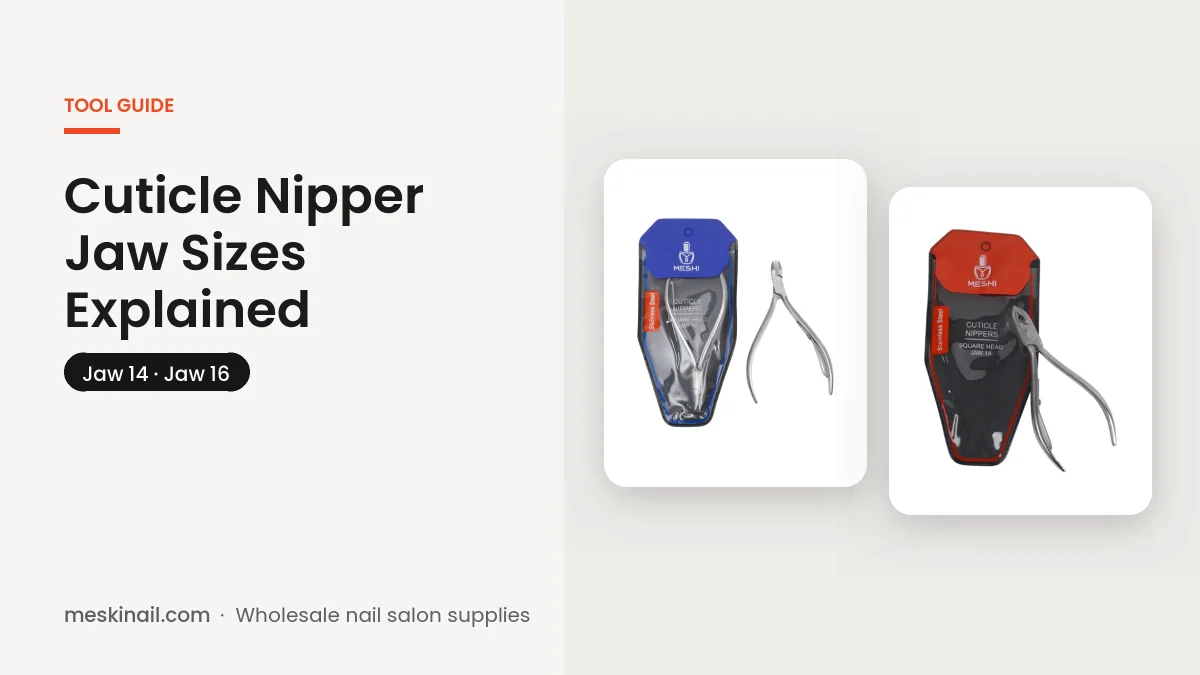
Cuticle nipper jaw size tells you how long the cutting edge is. By a common industry convention, jaw 12 is a quarter jaw (the shortest), jaw 14 is a half jaw and jaw 16 is a full jaw (the longest). A longer jaw takes more with each snip; a shorter jaw gives more control in tight spots.
The numbers are size codes, not millimeters, and exact blade lengths vary by brand. Jaw 14 is a common everyday size, and jaw 16 suits experienced hands that want a longer cut.
Whatever size you choose, nippers must be cleaned and disinfected (or sterilized) before every client. California is our example state for those rules; rules differ by state, and this is general information, not legal advice.
Key takeaways
- Jaw 12 = quarter jaw, jaw 14 = half jaw, jaw 16 = full jaw. A higher number means a longer cutting edge, but exact lengths differ by brand.
- Jaw 14 is a common all-round size, jaw 16 takes a longer cut per snip, and jaw 12 is for detail work.
- Trim only loose, dead tissue and hangnails. Never cut living skin, and stop if you draw blood.
- In California, nippers are cleaned, dried and fully immersed in an EPA-registered disinfectant before every client.
- Keep two or three pairs per technician so a disinfected pair is always ready.
What cuticle nipper jaw size means
The jaw is the pair of cutting blades at the tip of the nipper. The jaw number is a size code for how long those blades are: the higher the number, the longer the cutting edge. Makers also call the same sizes quarter, half and full jaw.
There is no single standard for the exact length: the maker and supplier size guides we checked give overlapping ranges. Treat the table as typical, and compare listed blade lengths when you switch brands.

| Jaw size | Also called | Typical blade length (varies by brand) | Good for |
|---|---|---|---|
| Jaw 12 | Quarter jaw | About 0.16–0.22 in (4–5.5 mm) | Small, precise snips: hangnails, tight corners and detail work |
| Jaw 14 | Half jaw | About 0.20–0.26 in (5–6.5 mm) | Everyday cuticle work; a common all-round size |
| Jaw 16 | Full jaw | About 0.24–0.30 in (6–7.5 mm) | A longer cut per snip for experienced techs and larger areas, such as pedicure work |
Size guides also disagree on which cuticle nipper jaw size suits beginners. Some point new techs to jaw 12 for control; others suggest starting with jaw 14 as the all-rounder.
How to choose: jaw 12, 14 or 16
Cuticle nipper jaw 14: the everyday size
A cuticle nipper jaw 14 balances reach and control. It handles most manicure and pedicure cuticle work and still takes a single hangnail cleanly. Two size guides we checked call it the most popular or standard size, a sensible pick if your team shares one size.
Cuticle nipper jaw 16: a longer cut
A cuticle nipper jaw 16 takes more with each closing, so it covers larger areas in fewer snips, and some size guides point pedicure specialists to it. The trade-off is less precision in tight corners, so it suits techs with steady, practiced hands.
Jaw 12: detail work
The short jaw makes tiny snips and reaches into tight corners. Techs who do fine detail work, or who are still building control, may prefer it.
What makes the best cuticle nippers for nail techs
The best cuticle nippers for nail techs cut cleanly instead of tearing, with tips that meet exactly when closed and a joint that moves smoothly. They should also stand up to cleaning and disinfection after every client. Try a size in your own hand before you buy for the whole team.
Meski cuticle nippers: blue jaw 16 and red jaw 14
Our stainless steel cuticle nippers have a square head and come in two jaw sizes, marked by color: blue is jaw 16 and red is jaw 14. They cost $9.90 each, an example price from meskinail.com at the time of writing (September 2026); check the product page for current pricing.

The color tells the sizes apart at a glance, even in the disinfection container. Stocking three pairs per technician costs 3 × $9.90 = $29.70. A salon with six technicians needs 18 pairs, or 18 × $9.90 = $178.20.
How to use cuticle nippers safely
- Prep first. Soften the area and gently push back the cuticle so you can see what is loose. Our guide on how to standardize nail prep covers these steps and warns against aggressive cutting.
- Trim only loose, dead tissue and hangnails. Never cut living skin around the nail.
- Take small snips with the tips. Close the nippers fully for a clean cut instead of pulling or tearing.
- Use a disinfected or freshly unsealed pair for every client, and wear gloves.
- Skip broken or infected skin. OSHA’s page on biological hazards in nail salons advises avoiding clients with cuts, open wounds or sores, blisters or visibly infected skin on the hands, feet or nails. Refer clients with health concerns to a physician or podiatrist.
- If you draw blood, stop. Follow your salon’s blood-exposure procedure. OSHA advises not touching the blood: the person presses a cotton ball or tissue on the spot and throws it directly in the trash once the bleeding stops. Put the nippers in the used-tool container right away.
For owners: OSHA’s Bloodborne Pathogens Standard covers nail salons. Employers must assess whether workers may contact blood and, if so, follow the standard, including training, vaccination and protective equipment.
How to clean and disinfect cuticle nippers
Unlike files and buffers, which are thrown away after one client (see can nail files be reused), nippers are cleaned, disinfected and used again. California lists cuticle nippers as non-electrical tools (16 CCR § 977), and its definitions call for a liquid disinfectant on those tools. Here is how to clean cuticle nippers and disinfect them before every client, in the order set by 16 CCR § 979:
- Drop used nippers in the “Dirty” container. After the service, put them in a container labeled “Dirty”, “Soiled” or “Contaminated”.
- Remove all visible debris. Brush the jaws, the inside of the blades and around the joint.
- Clean with soap or detergent and water. Scrub while opening and closing the nippers so the water reaches the joint, then rinse.
- Dry completely with a new, clean paper towel.
- Totally immerse in an EPA-registered disinfectant with bactericidal, fungicidal and virucidal activity, used as the label directs, including the contact time. Keep the nippers open so the solution reaches every surface, and keep the container covered.
- Remove them with gloves or tongs, such as our latex gloves. Rinse and dry if the disinfectant label says to.
- Store them in a clean, covered place labeled “Clean” or “Disinfected”. Whatever holds them must itself be disinfectable: § 979(e) bars putting disinfected tools in a container, pouch or holder that can’t be disinfected.
Two more California details: the disinfectant must stay covered and be changed as the label directs or whenever it is cloudy or has debris in it (§ 979(b)), and its container must be labeled “Disinfectant Solution” and hold enough to fully immerse the tools (16 CCR § 978).
OSHA’s guidance lists soaking tools for 10 to 30 minutes, according to the manufacturer’s directions. It also points out that UV boxes do not disinfect tools; use them only to store tools that are already clean and disinfected.
Sterilizing nippers in an autoclave
If your salon has an autoclave, you can clean the nippers, seal them in one of our self-sealing sterilization pouches and sterilize them instead. Under § 979(h), California treats tools sterilized under its sterilization rule as meeting the disinfection requirements. Confirm that the nipper maker allows autoclaving, then follow our guide on how to use sterilization pouches.
How many pairs of nippers per technician
Plan for rotation. While one pair is on the client, a second pair should already be through disinfection, and a third covers back-to-back bookings, a dropped pair or one out for sharpening. That is why we suggest at least two, and ideally three, pairs per technician.
For example, with a 10-minute contact time, cleaning, soaking and drying one pair can take close to 20 minutes, so a tech who starts a new client every 30 minutes needs two pairs to keep up. Rotation is the practical answer to how to disinfect cuticle nippers between back-to-back clients: you never cut the contact time short; you switch to the next pair.
If you sterilize in batches, each tech needs a sealed pair for every client between autoclave runs, plus a spare or two for clients who arrive during the cycle. For example, 4 clients between runs means 5 or 6 pairs. Our nail salon supply list includes nippers for every station.
Care tips that keep nippers cutting cleanly
- Dry them thoroughly, especially the joint. Moisture left in the joint can cause rust spots.
- Check them every time. Open and close the nippers: the motion should be smooth and the tips should meet exactly.
- Oil the joint only if the maker allows it. Use the product their care instructions name, one small drop, and wipe off the extra.
- Protect the tips. Don’t drop nippers or toss them in with other metal tools, and don’t use cuticle nippers to cut nails, tips or enhancement product.
- Store them in a labeled, clean, covered container that can itself be disinfected.
When to sharpen or replace cuticle nippers
Sharpen or replace a pair when you notice any of these signs:
- It tears or pulls tissue instead of cutting cleanly.
- The tips don’t meet, cross over or leave a gap when closed.
- The joint feels loose, wobbly or gritty.
- Rust, pitting or nicks along the blades don’t come off with cleaning.
- The spring is weak or broken, so the nippers don’t reopen on their own.
A professional sharpening service can restore many pairs, so compare its cost and turnaround with the price of a new pair. There is no fixed schedule; one maker’s guide suggests sharpening every 6 to 9 months with daily salon use, but let the signs above decide.
FAQ
What is the best jaw size for cuticle nippers?
There isn’t one best cuticle nipper jaw size for everyone. Jaw 14 (half jaw) is a common all-round choice, jaw 16 (full jaw) gives a longer cut for experienced techs, and jaw 12 (quarter jaw) gives the most control for detail work. Stocking two sizes lets each technician use what suits their hands.
What is the difference between jaw 14 and jaw 16 nippers?
The length of the cutting edge. Jaw 16 is a full jaw with a longer blade, and jaw 14 is a half jaw with a shorter one; exact lengths vary by brand. Jaw 16 takes more per snip, while jaw 14 is easier to control in tight spots.
How do you disinfect cuticle nippers between clients?
In California, remove visible debris, wash with soap or detergent and water, dry with a new paper towel and fully immerse the nippers in an EPA-registered disinfectant for the label’s contact time. Remove them with gloves or tongs and store them in a clean, covered container labeled “Clean” or “Disinfected”. Other states set their own rules, so check with your board.
Can cuticle nippers go in an autoclave?
Only if the maker says the tool can be steam sterilized. If so, clean the nippers, seal them in a sterilization pouch, run the cycle and check the indicator. Keep them sealed until you open the pouch in front of the client.
Pick the cuticle nipper jaw size that fits your hands, then build the cleaning routine around it so a disinfected pair is always ready. Browse our nail tools, and for help choosing sizes or quantities, call +1 (669) 696-7724, email contact@meskinail.com or reach us through our contact page.


