

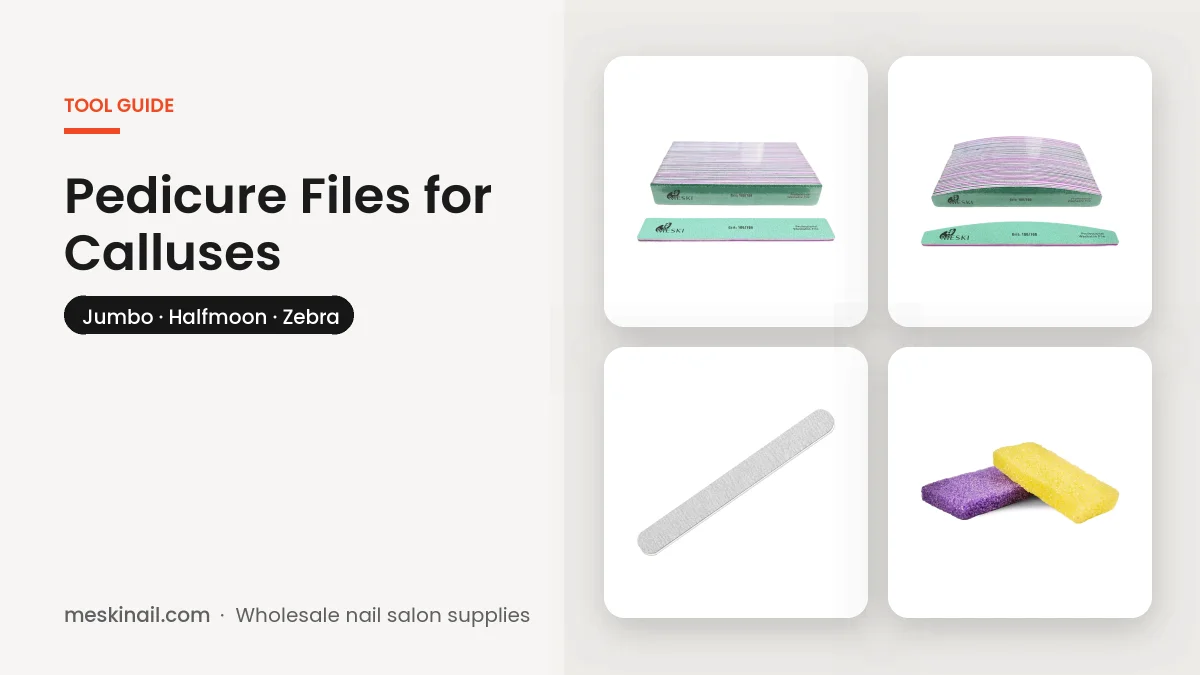
The best pedicure files for calluses pair the right grit with the right shape. Use a coarse 80 grit file on thick, hard callus, a 100 grit file to smooth what the coarse file leaves behind, and a pumice pad to finish. For shape, a straight jumbo board covers the heel fast, a halfmoon file follows the curves of the foot, and a regular zebra file handles smaller spots.
Technique matters as much as the file. Work on clean skin with light pressure, smooth the callus instead of removing all of it, and stop at the first sign of redness. A file that touches skin can’t be disinfected, so every client gets a new one, and the price per file matters too.
Below: the three shapes, what grit numbers mean, a step-by-step salon routine and the cost per file for each Meski pedicure file.
Key takeaways
- A lower grit number means a coarser file. Use 80 grit for thick callus, 100 grit to smooth and a pumice pad to finish.
- Choose the shape by area: jumbo boards for the heel and the ball of the foot, halfmoon files for curves, regular zebra files for small spots.
- Smooth and reduce callus. Don’t remove it all in one visit, stop at any redness and never file broken skin.
- For clients with diabetes or poor circulation, skip callus work and refer them to a podiatrist or physician.
- Pedicure files are single-use. At example case prices, Meski pedicure files cost about $0.15 to $0.45 each.
Pedicure file shapes: jumbo, halfmoon and regular zebra
All three shapes work as pedicure files for calluses. The difference is how much skin each stroke covers and how well the file follows the curves of the foot. Keep two shapes on the cart so you can match the file to the area.
Straight jumbo board
A jumbo nail file is a long, wide, straight board. The big flat surface covers the heel and the ball of the foot in fewer strokes and spreads your pressure over more skin, which helps keep the result even. That makes it a strong first choice for thick heel callus. The trade-off is control: a wide board is harder to steer around the toes.
Halfmoon (crescent) file
A halfmoon file is curved like a crescent. The curve follows the rounded back of the heel and the outer edge of the big toe, so you can work curved areas without the corner of a straight board catching the skin. It is a good second file for techs who find a jumbo board too big for detail work.
Regular zebra file
A regular zebra file is a standard-size file with the classic striped zebra pattern. It is smaller than a jumbo board, which makes it handy for the sides of the toes, the edges of the heel and quick touch-ups. On a large, thick heel callus it is slower, because each stroke covers less area.

Pedicure file grit: what the numbers mean
When you choose pedicure files for calluses, grit matters more than shape. The grit number tells you how coarse the abrasive surface is: the lower the number, the larger the abrasive particles and the more skin each stroke removes. So 80 grit is coarser than 100 grit, and 100 grit is coarser than 180 grit.
A file marked 80/80 has 80 grit on both sides, and a 100/100 file has 100 grit on both sides. Meski pedicure files come in 80/80 or 100/100, so a two-step routine uses two files: one to reduce and one to smooth. Check the grit printed on the file before you start.
| Grit | Coarseness | Best use in a pedicure |
|---|---|---|
| 80 | Coarse | Thick, hard callus on the heel, the ball of the foot and the outer edge of the big toe. First pass only, with light pressure. |
| 100 | Medium-coarse | Light to moderate callus, and smoothing the scratch marks an 80 grit file leaves. |
| 180 | Medium-fine | Softening rough edges after callus work, and shaping natural toenails. |
| 240 | Fine | Final smoothing of natural toenail edges. |

Match the grit to the callus
Start with the finest grit that still makes progress. If a 100 grit file is smoothing the heel, you don’t need the 80. Save the coarse file for thick, hard buildup, and switch to a finer surface as soon as the area feels even. For clients with light buildup, one 100/100 file and a pumice pad may be all you need, which also keeps your cost per service down.
Where the pumice pad fits
A pumice pad is gentler than a file. Use it alone on light buildup, or as the last step after filing to blend the surface before the scrub and massage. Like files, pumice pads can’t be disinfected, so treat them as single-use. Our post Pumice Stones Explained covers them in more detail, and you can buy mini pumice pads by the carton in our buffers and pumice category.
How to use pedicure files for calluses safely
Use the same routine on every client so results stay even from tech to tech.
- Check the feet first. Ask whether the client has diabetes, poor circulation or numbness in the feet. Look for cuts, cracks, blisters, redness or signs of infection. If you find any of these, skip callus work (see below).
- Start with clean skin. Softened skin files quickly, so use lighter pressure after a soak.
- Open a new file. Use the coarse file only on thick areas: the heel, the ball of the foot and the outer edge of the big toe.
- Use light, even strokes. Keep the file moving and let the grit do the work. Pressing hard makes it easy to overdo one spot.
- Check often. Run your hand over the area. Stop when it feels smooth and even, not when the callus is gone.
- Smooth and finish. Switch to the 100 grit file, then finish with a pumice pad. Rinse and moisturize.
- Stop at any redness. Stop right away if the skin turns red or feels warm, or if the client says it feels tender.
- Throw it away. Discard the file, pumice pad and buffer after the service.
Don’t remove all the callus in one visit
A callus is thick skin that builds up where the foot takes repeated pressure or friction, and MedlinePlus describes that thickening as a protective reaction. If you file down to thin, pink skin, the client can walk out sore. Reduce a little at each visit instead, and let regular pedicures keep the callus under control.
When to skip callus work and refer out
Do not reduce callus on a client who tells you they have diabetes, poor circulation or numbness in their feet. The CDC notes that nerve damage from diabetes can lower a person’s ability to feel pain, and it tells people with diabetes not to remove corns or calluses themselves. Your client may not feel it when you go too far.
Offer a gentle service without callus reduction, and suggest they see a podiatrist or physician. Do the same for open sores, bleeding cracks, swelling or anything that looks infected: don’t file, and refer the client out.
Use only files and pumice for callus work. Some states ban razor-type callus tools in salons; California’s rules, for example, don’t allow razor-edged tools for removing calluses on salon premises. Rules differ by state, so check with your state board.
Hygiene: why pedicure files are single-use
A file that has touched a client’s skin can’t be disinfected, because skin debris gets trapped in the abrasive grit. That is why disposable pedicure files, buffers and pumice pads are used on one client and then thrown away. Rules differ by state; for the details, read our guide on whether nail files can be reused on clients.
A new file for each client also gives you consistent results, because a fresh surface cuts evenly while a worn one drags. For more on file life, see our post on how often to replace your nail files.
Meski pedicure files compared: cost per file
Here are the Meski pedicure files for calluses side by side. Prices are example case prices from meskinail.com at the time of writing (September 2026); follow the product links to check current pricing. Price per file is the case price divided by the number of files in the case.
| File | Shape | Grit options | Pack size | Case price | Price per file |
|---|---|---|---|---|---|
| Jumbo Nail File 80/80 | Jumbo board | 80/80 | 1,000 files per case | $150 | $150 ÷ 1,000 = $0.15 |
| Pedicure File Premium Jumbo, Green | Jumbo board | 80/80, 100/100 | 1,000 files per case | $176 | $176 ÷ 1,000 = $0.18 |
| Pedicure File Regular Jumbo, Green | Jumbo board | 80/80, 100/100 | 1,000 files per case | $320 | $320 ÷ 1,000 = $0.32 |
| Pedicure File Premium Halfmoon, Green | Halfmoon (crescent) | 80/80, 100/100 | 1,000 files per case | $320 | $320 ÷ 1,000 = $0.32 |
| Pedicure File Meski Regular Zebra | Regular zebra | 80/80, 100/100 | 1,000 files per case | $450 | $450 ÷ 1,000 = $0.45 |
The Jumbo Nail File comes in 80/80 only, so pair it with a 100/100 file when you need a smoothing step. To budget a two-step routine on thick callus, add the files together: an 80/80 Premium Jumbo to reduce plus a 100/100 Premium Jumbo to smooth costs 2 × $0.176 = $0.352, about $0.35 per client.
If you prefer to open one pack per client, each Pedicure Kit 4 PE set includes a 5-inch 80/80 zebra file, a pumice pad, an 80/100 buffer and a 4-toe separator, individually packaged. At $25 for 200 sets, that is $25 ÷ 200 = $0.125, about $0.13 per client. Add a jumbo or halfmoon file only for clients with heavier callus.
Those cents belong in your supply cost per service. Our guide on how much to charge for a pedicure shows how to build supply cost into your price, and our guide to nail salon inventory management covers how many cases to keep on the shelf.
FAQ
What grit pedicure file is best for calluses?
For thick, hard callus, start with an 80 grit file and follow with 100 grit to smooth. For light buildup, a 100 grit file or a pumice pad is usually enough. Use the finest grit that still makes progress.
Is a foot file or a pumice stone better for calluses?
They do different jobs. A foot file for calluses takes down thick buildup faster and gives you more control on large areas like the heel. A pumice pad is gentler and works well on light buildup and for the final smoothing pass, so many pedicures use both: file first, pumice last.
Can you reuse a pedicure file on another client?
No. A file that has touched a client’s skin can’t be disinfected, so throw it away after one service. State rules differ, so check with your state board for the exact requirements.
What is a halfmoon nail file used for?
A halfmoon nail file has a curved, crescent shape. In pedicures, it smooths callus on curved areas such as the back of the heel and the side of the big toe, where the corner of a straight file can catch the skin.
How much callus should you remove in a pedicure?
Only enough to leave the area smooth and even. Callus protects the skin underneath, and filing it down to thin skin can leave the client sore. Reduce a little each visit, and stop at the first sign of redness or tenderness.
Restocking pedicure files for calluses? Browse our nail files to compare shapes and grits, or reach the Meski team through our contact page, at +1 (669) 696-7724 or at contact@meskinail.com with questions about case orders and shipping.


